
AI UGC Video Prompts for MiniMax H3: Product Ads That Sound Like a Real Creator
 Chywe, Head of Product at HelloGen
An AI UGC ad that works needs three things: a person who looks like they filmed it on their phone, a product that looks exactly like the one in your shop, and a line that sounds like a friend talking. MiniMax H3 can do all three in one render — it takes your photos as references and speaks in sync with the picture, in English, Portuguese, Spanish and the other languages H3 supports. The short version: name each photo as a <Subject>, say in retention_analysis what must not change, and put every spoken line inside <d>[language] … </d>. Below is why each one matters, with a 15-second template — and both clips on this page were rendered on HelloGen with the prompt shown.
✦ Try MiniMax H3 Unlimited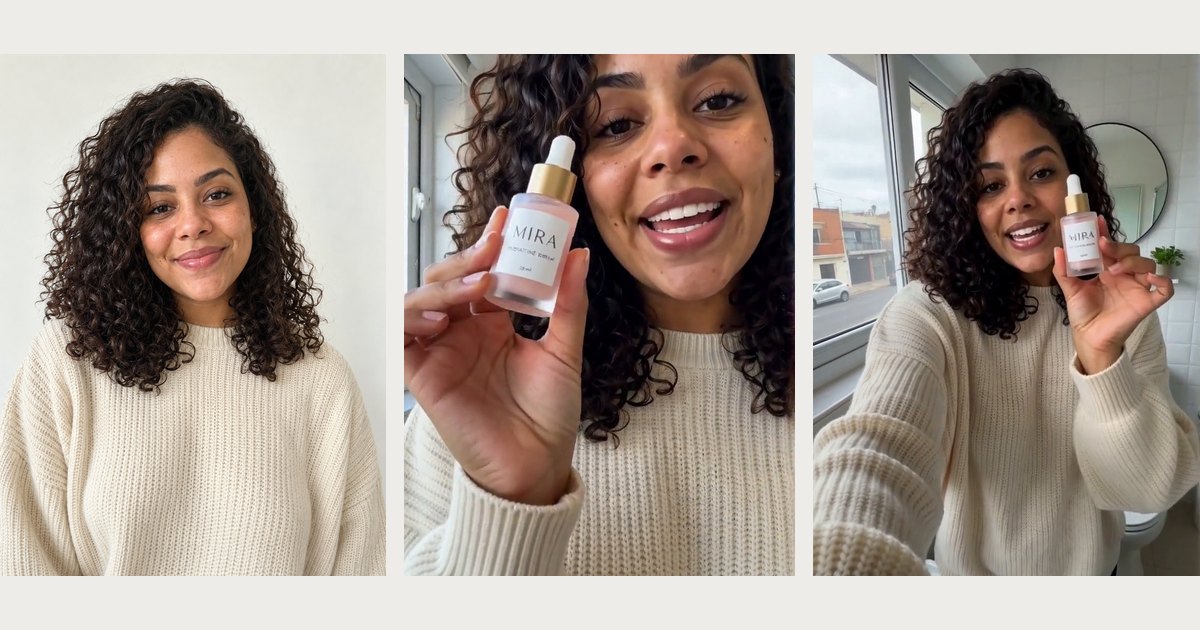
Three things most UGC prompts leave out
Most UGC prompts do the hard part — they attach a photo of the creator and a photo of the product. Then the writing gives it away.
| Usually missing | What happens | The fix |
|---|---|---|
| A label for each photo | The model guesses which picture is the person and which is the product | <Subject 1> is the woman in <Picture 1>; <Subject 2> is the bottle in <Picture 2> |
| A line saying what must not change | The product comes back with a different shape, colour or label | retention_analysis: exact shape, colours and label, fully_preserved |
| Dialogue markers around each line | Speech-shaped noise, or the right words in the wrong mouth | (S1) says: <d>[Portuguese] …</d> |
Two photos, two jobs: the creator and the product
Attach the creator first and the product second, and say which is which. In HelloGen’s video composer type @ and pick them; they reach H3 as <Picture 1> and <Picture 2>. MiniMax’s reference syntax turns each into a subject the shots can point at (h3-prompt-writing on GitHub):
<Subject 1> is the woman in <Picture 1>, mid-twenties, dark curly hair, oversized cream sweater. <Subject 2> is the serum bottle in <Picture 2>.
Then two rules keep the product looking like your product:
- Do not describe the product in the shots. On our own H3 runs, whenever the words and the photo disagreed, the words won: a cup grew a handle it does not have, another product came back silver because the text said silver eight times, a third lost its logo. Write “keeps its exact shape, colours and label” in retention_analysis and stop there.
- Keep the product, not the photo. Add “do not reuse the reference’s background”. Without it, one of our launch clips pasted the white-background packshot into its final second — background and all — like a sign across the creator’s chest.
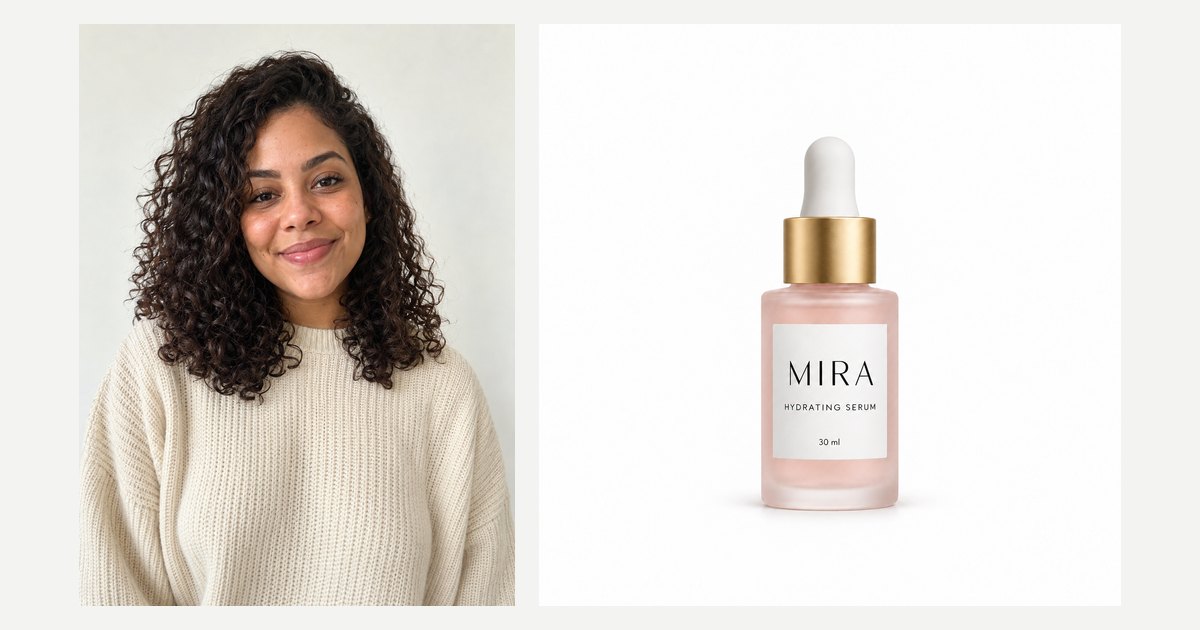
For the photos themselves: one product, centred, plain background, label facing the camera, no hands. One creator, face large in the frame, wearing what they wear in the ad — like the two below. Keep label text big and simple: in our clips the MIRA wordmark stayed readable, while the small print under it blurred.
The 15-second UGC beat sheet
Most UGC ads follow the same arc — hook, proof, verdict, call to action. On H3 the timing matters as much as the arc: a spoken line every 3 to 4 seconds, and any silent stretch marked as silent. Leave a gap unexplained and the model fills it with talk you never wrote.
| Time | Shot | On screen | Sound |
|---|---|---|---|
| 0:00–0:03 | Hook — waist-up, front camera | The creator looks into the lens, product in hand | The hook line |
| 0:03–0:08 | Proof — close-up, no face | The one thing that proves it: the dropper, the texture, the fizz, the fit | Product sounds only, marked as silent |
| 0:08–0:12 | Reaction — face back in frame | She lowers the product, reacts, then speaks | The verdict line |
| 0:12–0:15 | Close — product beside her face | Label to the lens, the camera settles | A soft call to action |
Lines that lip-sync, in your buyers’ language
Act first, then speak. Every line goes in a shot where the creator faces the camera with the mouth visible, and the action happens before or after it in silence. “She takes a sip, lowers the can, then says…” — the lowering is what keeps the lips on screen. A line spoken mid-sip, mid-bite or over a close-up of the product is where lip-sync breaks.
Markers, ID and language tag. <Subject 1>, a woman in her twenties with a bright, quick Brazilian Portuguese voice (S1), says: <d>[Portuguese] Gente, olha a textura desse sérum.</d> MiniMax’s guide wants the rest of the prompt in English and the line in the language it is spoken in, word for word, with the speaker’s description — accent included — before “says:”.
Nothing straight after </d>. Text written right after the closing marker gets read out: we watched a voice description get spoken, word for word. Start the next action as a new beat instead.
Claims come from you. If the bottle says 30 ml, the line can say 30 ml. A result, an ingredient or a number your product page cannot back up has no place in the line.
Five UGC formats, and the beat each one needs
Same structure, different proof shot. Pick the format by what your buyer needs to see before they believe you.
| Format | The beat that sells it | Watch out for |
|---|---|---|
| Unboxing | The first look as the product comes out | Tape, zips and lids are what video models draw worst — cut from the closed box to the product in hand |
| Review or taste test | One visible test: the sip, the swipe, the blend | The line comes after the sip, never during it |
| Problem → solution | The problem on screen first, then the product fixing it | Same person, same room in both halves |
| Before / after | Same framing, same light, one side against the other | Two different shots read as two different products |
| Try-on | A turn to the camera that shows the fit | Let the photo carry the outfit; do not describe it again |
A copy-ready UGC product video prompt (15 seconds)
Two references: the creator first, the product second — @Image1 and @Image2 in HelloGen’s composer, <Picture 1> and <Picture 2> to H3. Vertical 9:16, 15 seconds. Swap in your own photos, room and lines; keep the structure.
subject_definitions: <Subject 1> is the woman in <Picture 1>, mid-twenties, dark curly hair, oversized cream sweater. <Subject 2> is the serum bottle in <Picture 2>. <Subject 3> is her bathroom: white tiles, a round mirror, a small plant on the shelf, soft morning light from a window at frame left.
summary: [reference generation] A phone-filmed UGC ad: <Subject 1> shows <Subject 2> to her front camera in <Subject 3>, tries it on the back of her hand and gives a short verdict.
retention_analysis: <Subject 1> (appears in [Shot 1], [Shot 3], [Shot 4]): fully_preserved - face, curly hair and cream sweater are retained. <Subject 2> (appears in [Shot 1], [Shot 2], [Shot 3], [Shot 4]): fully_preserved - exact shape, colours and label, readable whenever it faces the camera. Do not reuse either reference’s background.
detailed_description: Vertical handheld phone footage with slight natural shake, real skin texture, no filters, no on-screen text. [Shot 1] Waist-up, front camera at arm’s length: <Subject 1> faces the lens holding <Subject 2> beside her cheek. <Subject 1>, a woman in her twenties with a bright, quick Brazilian Portuguese voice (S1), says: <d>[Portuguese] Gente, olha esse sérum que chegou.</d> [Shot 2] At 00:03.000, the shot cuts to a close-up of her hands: she squeezes the dropper once onto the back of one hand and spreads the drop with two fingers; it glistens in the window light. No one speaks; only the soft click of the dropper. [Shot 3] At 00:08.000, back to the front camera: she lowers her hand, looks into the lens, and (S1) says: <d>[Portuguese] Super leve, não fica grudando.</d> [Shot 4] At 00:12.000, she lifts <Subject 2> beside her face with the label to the lens; the camera settles, and (S1) says: <d>[Portuguese] O link tá aqui embaixo.</d>
overall_soundscape: A small tiled bathroom with a light echo, the dropper’s click, a soft rub of skin, distant street noise through the window.
non_diegetic_music: N/A
Same ad, another market: new lines, new accent
Changing market means rewriting the three lines and the accent in the voice description, and nothing else — same photos, same shots, same timing. For Spanish-speaking buyers:
<Subject 1>, a woman in her twenties with a bright, quick Latin American Spanish voice (S1), says: <d>[Spanish] Miren el sérum que me llegó.</d> … <d>[Spanish] Súper ligero, no se siente pegajoso.</d> … <d>[Spanish] El link está aquí abajo.</d>
For English, the hook might be <d>[English] Okay, look what just came in.</d> Render each market’s version from the same photos and you have one campaign in several languages, with the same creator and the same bottle in every one.
Keep it honest — and on TikTok, label it
AI UGC is allowed; passing it off as a real customer is not. TikTok requires creators to label realistic AI-generated content (TikTok newsroom), and in the US the FTC’s rule on reviews and testimonials, announced in August 2024, bans fake testimonials — including AI-generated ones that pretend to come from someone who does not exist (FTC). Three habits keep an ad on the right side: switch on TikTok’s AI-generated label, write the creator as someone showing the product, not a buyer reporting results, and claim only what the product page backs up. TikTok Shop sets its own rules for shoppable videos, so read the current version before you post. This is general information, not legal advice.
Test ten hooks, keep one — at 0 credits per clip
The hook decides whether anyone sees the rest, and the reliable way to find a good one is to render several. That is where H3 Unlimited earns its place: on HelloGen Pro (from $19.90 a month) and Max, MiniMax H3 Unlimited costs 0 credits per clip with no daily cap — at least 2 priority clips a day on Pro and 5 on Max, standard speed after that. Keep the photos and the beat sheet fixed, change only the hook line, and render each version; then repeat for each market’s language.
Pro renders at 480p, and the video upscaler doubles the winner’s resolution for 2 credits per 15 seconds; Max adds unlimited 720p HD. Your plan’s credits also run the hosted MiniMax H3 at native 2K, Seedance 2.5, Kling 3.0 and Veo 3.1 for a final cut. And if writing labels and markers is not how you want to spend the afternoon, describe the ad in plain words, attach the two photos and press ✦ Enhance: it rewrites your idea into H3’s reference form, is built to keep your lines word for word and not add new ones (read the result before you render) — 2 credits, charged only when it succeeds. Building a recurring character instead of a one-off ad? The short-drama guide covers faces and voices across episodes.
Sources
- MiniMax-H3 h3-prompt-writing skill on GitHub — reference labels, retention_analysis, dialogue markers, language tags, and the speaker description (accent included) before the line.
- TikTok newsroom, 9 May 2024 — creators are required to label realistic AI-generated content.
- FTC, August 2024 — the final rule banning fake reviews and testimonials, including AI-generated ones.
- The clips on this page — rendered on HelloGen’s MiniMax H3 Unlimited at 720p, October 2026, with the prompts shown.
- HelloGen’s own H3 runs, September 2026 — words against the photo, a reused packshot background, text after </d>.
- Related: MiniMax H3 prompt guide for short dramas and why MiniMax H3 speaks gibberish.
Frequently asked
Can MiniMax H3 make UGC product ads?
Yes. In reference mode H3 takes a photo of the creator and a photo of the product, renders 4 to 15 seconds in vertical 9:16, and speaks the lines in sync with the picture in the language you write them in. Name both photos as subjects and keep the product out of the shot descriptions.
How do I keep my product looking the same in an AI UGC video?
Attach a clean product photo, define it as <Subject 2> is the bottle in <Picture 2>, mark it fully_preserved in retention_analysis, and add “do not reuse the reference’s background”. Do not describe its colour, material or logo in the shots: when words and photo disagree, the words win.
How do I make an AI UGC creator speak Portuguese or Spanish?
Write the line in that language inside H3’s dialogue markers with a language tag — (S1) says: <d>[Portuguese] the line.</d> — and put the accent in the speaker’s description before “says:”, for example “a bright, quick Brazilian Portuguese voice”. Keep the rest of the prompt in English.
How long should an AI UGC ad be?
Fifteen seconds is enough for a hook, a visible proof, a verdict and a soft call to action in one MiniMax H3 clip. Shorter ads drop length from the proof shot, not a line; longer ones join two clips in an editor.
Are AI-generated UGC videos allowed on TikTok and TikTok Shop?
TikTok allows them but requires creators to label realistic AI-generated content, and US rules ban fake testimonials, including AI personas presented as real customers. Turn on the AI-generated label, show the product rather than report invented results, TikTok Shop applies its own rules to shoppable videos, so check its current policy before you post.
Why does the creator keep talking after the line ends?
A short line in a long clip leaves seconds the model fills on its own, and text written straight after </d> gets spoken. Give the clip a line every 3 to 4 seconds or say which seconds are silent, describe the ambient sound, and keep directions before “says:”.